
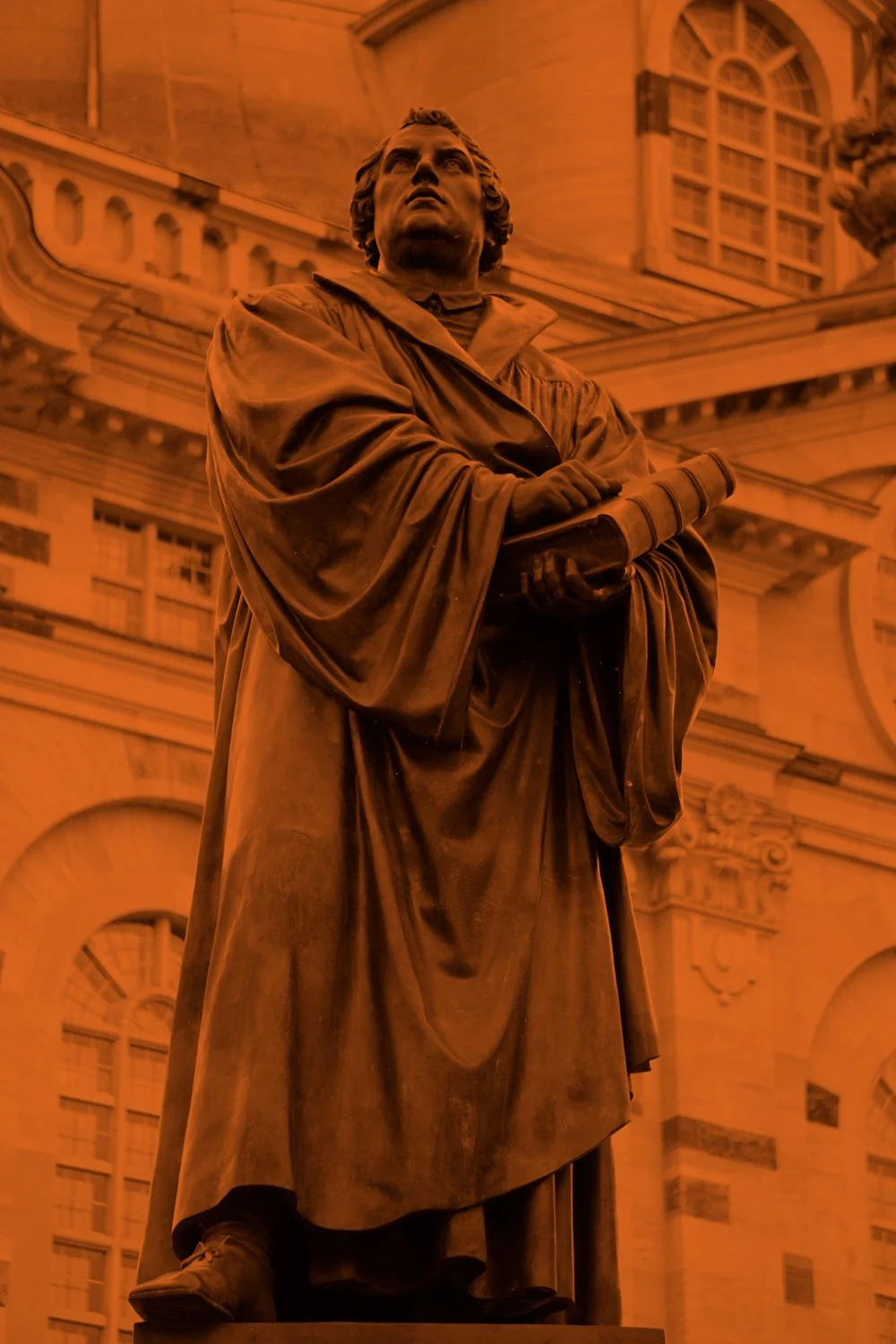
This is the fifth and final week exploring the five solas of the Reformation. The word “sola” in Latin means “only” and these five solas are statements from the Protestant Reformation that outline some of the major disagreements between Protestants and Catholics. This week I want to explore the idea of soli Deo gloria which means “Glory to God Alone.”
Soli Deo Gloria is in many ways is the central statement of the entire Reformation, and it sums up all the other statements. When we think about Scripture alone, Christ alone, faith alone, and grace alone, what we’re really trying to communicate is that salvation is a work of God from beginning to end. And because it is a work of God from beginning to end, he gets all the glory. If we, or a church, or a preacher, or a pope, or any other entity try to take credit for some part of salvation, we’re taking credit for what only God can do.
David VanDrunen says it this way:
“Christ alone, and no other redeemer, is the mediator of our salvation. Grace alone, and not any human contribution, saves us. Faith alone, and no other human action, is the instrument by which we’re saved. Scripture, and no merely human word, is our ultimate standard of authority. God’s glory alone, and that of no creature, is the supreme end of all things” [1]
A Central Theme of Scripture
The idea that God’s glory is central and ultimate is found everywhere in Scripture:
Isaiah 42:8
8 I am the LORD; that is my name; my glory I give to no other, nor my praise to carved idols.
2 Kings 19:34
34 For I will defend this city to save it, for my own sake and for the sake of my servant David.”
Isaiah 43:25
25 “I, I am he who blots out your transgressions for my own sake, and I will not remember your sins.
Isaiah 48:11
11 For my own sake, for my own sake, I do it, for how should my name be profaned? My glory I will not give to another.
God does everything for his own glory, and he will not give his glory to anyone else. In a healing encounter in John 9, Jesus explains that a man was born blind, so that he could later be healed by Jesus, so that God would get the glory:
John 9:1-3
1 As he passed by, he saw a man blind from birth. 2 And his disciples asked him, “Rabbi, who sinned, this man or his parents, that he was born blind?” 3 Jesus answered, “It was not that this man sinned, or his parents, but that the works of God might be displayed in him.
Why do you and I exist? The glory of God:
Isaiah 43:6-7
6 I will say to the north, Give up, and to the south, Do not withhold; bring my sons from afar and my daughters from the end of the earth, 7 everyone who is called by my name, whom I created for my glory, whom I formed and made.”
And on and on we could go. I encourage you to notice the glory of God as a central theme throughout the Scripture. It will likely blow you away (as it did for me when I was first made aware of this theme). Why do I exist? I exist for the glory of God. How should I pursue my job? In such a way that it glorifies God. How should I spend my money? In a way that glorifies God. How should I parent? In a way that glorifies God.
This is such a grounding and clarifying thought. We can make life about so many different things, but at the end of the day, we all exist for God. In 1 Corinthians 8:6, Paul says it this way:
1 Corinthians 8:6
6 yet for us there is one God, the Father, from whom are all things and for whom we exist, and one Lord, Jesus Christ, through whom are all things and through whom we exist.
And John Piper says it beautifully this way:
““The glory of God" is a way to say that there is an objective, absolute reality to which all human wonder, awe, veneration, praise, honor, acclaim, and worship is pointing. We were made to find our deepest pleasure in admiring the infinitely admirable—the glory of God. This glory is not the psychological projection of unsatisfied human longing onto reality. On the contrary, inconsolable human longing is evidence that we were made for God's glory” [2].
Protestants and Catholics
Now to be clear, the Catholic Church would absolutely agree that glory goes to God alone. However, because of the way they conceive of grace and faith and multiple mediators, and multiple sources of ultimate authority, we would argue that the net effect robs glory from God. Is this intentional? No! But Protestants are worried that the actual outcome of Catholic doctrine ends up taking away from God’s glory. As VanDrunen argues: “If the Roman Catholic doctrine of authority and doctrine of salvation are true, all glory thus does not belong to God alone” [2].
But let’s not just point the finger at Catholic doctrine. It’s very easy for us to do the same thing. It’s easy for us to think, “I’m so smart,” “I’m so moral,” “I’m such a good guy.” It’s easy for us to think that we’re Christians because of some internal goodness, when in reality the Bible says that “no one is righteous, no not one.” It’s easy for us to think “our church is the best” or all sorts of other unbalanced things. So let’s all constantly guard ourselves from claiming glory for what only God can do.
My hope in this whole series has been not to aggravate disagreements between Protestants and Catholics (many of whom I believe are our brothers and sisters), but to try to help us shore up what we believe. So please don’t hear me dogmatically trying to be a jerk, rather, let’s better understand our own doctrine, so that we can have peaceful discussions with others with whom we may disagree. And, let’s regularly go back to Scripture and ask “Is this what the Bible is teaching?” None of us has all our doctrine completely figured out. So, let’s keep reading the word of God, asking the Holy Spirit for help, and discussing with others in our community of faith. If we do, we’ll keep circling closer and closer to the truth.
And let us proclaim with the angels:
Luke 2:14
14 “Glory to God in the highest, and on earth peace among those with whom he is pleased!”
- Ben
[1] David VanDrunen and Matthew Barrett, God’s Glory Alone—the Majestic Heart of Christian Faith and Life: What the Reformers Taught…and Why It Still Matters, The 5 Solas Series (Grand Rapids, MI: Zondervan Academic, 2015), 14.
[2] John Piper, “Soli Deo Gloria,” https://learn.ligonier.org/articles/soli-deo-gloria.
[3] David VanDrunen and Matthew Barrett, God’s Glory Alone—the Majestic Heart of Christian Faith and Life: What the Reformers Taught…and Why It Still Matters, The 5 Solas Series (Grand Rapids, MI: Zondervan Academic, 2015), 15.